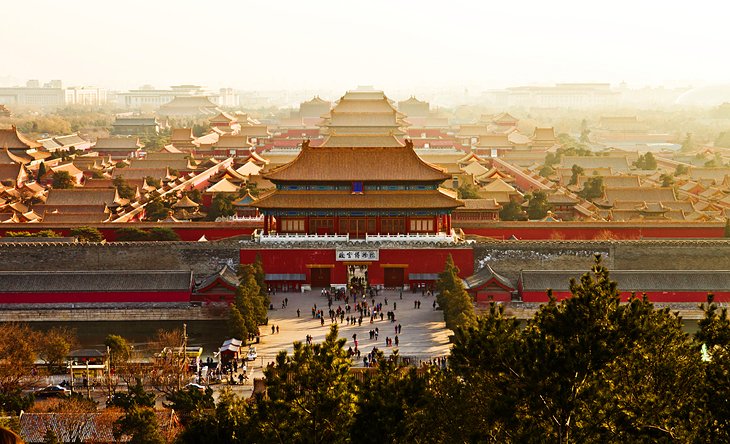
China’s largest and most important building, the Forbidden City — also known as the Imperial Palace — is situated in the very heart of Beijing and is a must-see when visiting the country. Started during the Yuan Dynasty between 1271-1368, much of the complex seen today (it’s really many splendid palaces in one) was built between 1406 and 1420 as the residence of 24 Ming and Qing Emperors, whose presence forbade the entry of anyone other than the imperial family and their courtesans.
Author: von sohot
Qinghai Lake
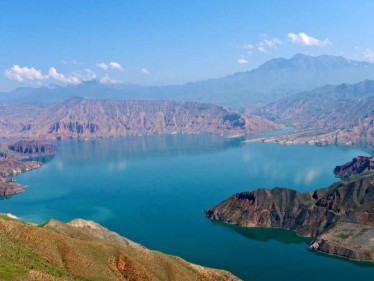
Qinghai Lake is the largest lake in China, spanning 1,616 square miles. Located in northwest China, this beautiful blue lake draws visitors in June and July when flocks of migratory birds can be seen flitting around Bird Island, which is found on the lake’s western shore. The pristine wilderness area around the lake is a popular spot for hiking, camping, and cycling. The scenery is a gorgeous mix of rolling green hills and lush farmlands dotted with sheep.
Yuanyang Rice Terraces

The Yuanyang Rice Terraces have been dug into the rolling landscape of the southern Ailao Mountains by the Hani people over many centuries. Covering more than 12,500 hectares, these shallow-sloped terraces reach height of up to 6500 feet above sea level. Depending on the season, the terraces are richly green or filled with water which reflects the colors and cloud shapes of the sky. Adding to the beauty of the terraces are the fascinating Hani people who farm the lands and still largely live according to the traditions of their ancestors.
The Dongchuan Red Land
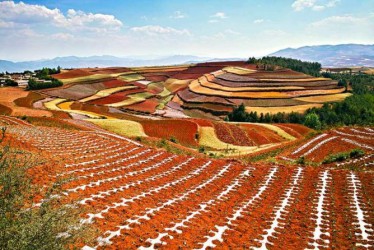
The Dongchuan Red Land is a 77,000-square mile area located about 25 miles southwest of Kunming City. The region’s subtropical climate causes iron to oxidize and deposit in the soil, which gives it a deep red color. The red soil color is emphasized by the other colors of the surrounding landscape, contrasting against green barley, golden buckwheat, white oil flowers, and the blue sky. Often described as a ‘palette’ of colors, the area is best visited from either May to June or September to November, when various crops are ripe and the colors are most distinct.
Juizhaigou’s
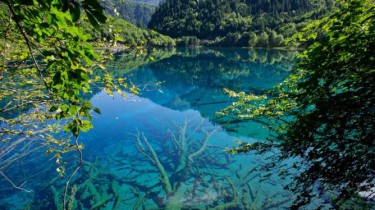
Jiuzhaigou’s enormous lake is filled with water that changes color throughout the day and year. The color is caused by a combination of algae and calcified rocks found at the bottom of the lake, as well as the reflection of the surrounding landscape. Autumn is the best time of year to visit the lake, when it takes on a rainbow of different hues.
 Amazing place in China